
Introduction: Archaeology and multi-disciplinarity
Since the Centre’s inception in 1966, archaeology has been a key part of its activities. In 1971 an important partnership was established between the University, the Castle Museum, the Record Office and the City Council’s Planning Department, with the aim of pulling together existing knowledge about the City’s past and also mitigate the destruction of archaeological information through uncontrolled development, thus the Norwich Survey was born with a home at UEA in the nacent CEAS.
The Norwich Survey was intended as a short-term project, to examine, record, synthesise and make public information on the origin and subsequent development of the city utilising a range of evidence including, documents, architecture and archaeology, the methodology developed to fulfil the projects aims was nothing short of ground-breaking.
Alan Carter was appointed as the Director of the Survey, having previously directed the latter stages of the King’s Lynn Archaeological Survey between 1968-71. The Norwich Survey was based in the Centre for East Anglian Studies and Alan was appointed also as its director, and, at the start, was the sole investigator with an initial annual budget of £1,000. The work was multidisciplinary with Alan focused on mainly archaeological evidence. Work on the topographic evidence contained within the rich documentary archive, mostly post 1280 in date, was carried out on a part-time basis by Helen Sutermeister with the assistance of many extra-mural students. An architectural survey of a range of historic buildings was also undertaken by members of the Norwich City Planning Department.
The Survey’s work concentrated on two research issues, the origins and early development of Norwich and the changes which took place from the later 16th through to 17th century with major population growth. An incredible thirty-eight sites were investigated between 1971-78 with interim reports published annually in Norfolk Archaeology. Almost all these sites were excavated in advance of redevelopment, prefiguring the future state of much subsequent archaeological research.
In 1978 this work culminated in two groundbreaking articles by Alan Carter, the first on early medieval origins of Norwich published in the journal Anglo-Saxon England and the second on the methodological issues faced in carrying out the task of sampling, investigating and synthesising the enormous amount of data collected. Research was central to the work of the survey with practical but focused questions regarding the early nature and development of the settlement. Hypothetical reconstruction maps formed an important part of the process of investigation and synthesis. In the event, this hypothetical, some might say rather positivist approach, sometimes came to incorrect conclusions but much was achieved along the way. For instance, Alan Carter underestimated the extent of the southern 10th century defences but his work underpinned the flurry of archaeological work that took place in the city subsequently and which has led to a good understanding of the origins of Norwich. This work has recently culminated in an East Anglian Archaeology Volume on the 7th to 11th century evidence, a belated but fitting legacy.
Further reading
Adams D.and G. Clarke 2023. Aspects of 7th- to 11th-century Norwich, East Anglian Archaeology 179.
Carter, A. 1978a. The Anglo-Saxon origins of Norwich: problems and approaches, Anglo-Saxon England 7, 175-204.
Carter A. 1978b. Sampling in a medieval town: the study of Norwich, in JF. Cherry, C. Gamble and S. Shennan (eds.), Sampling in contemporary British Archaeology, BAR British Series 50.
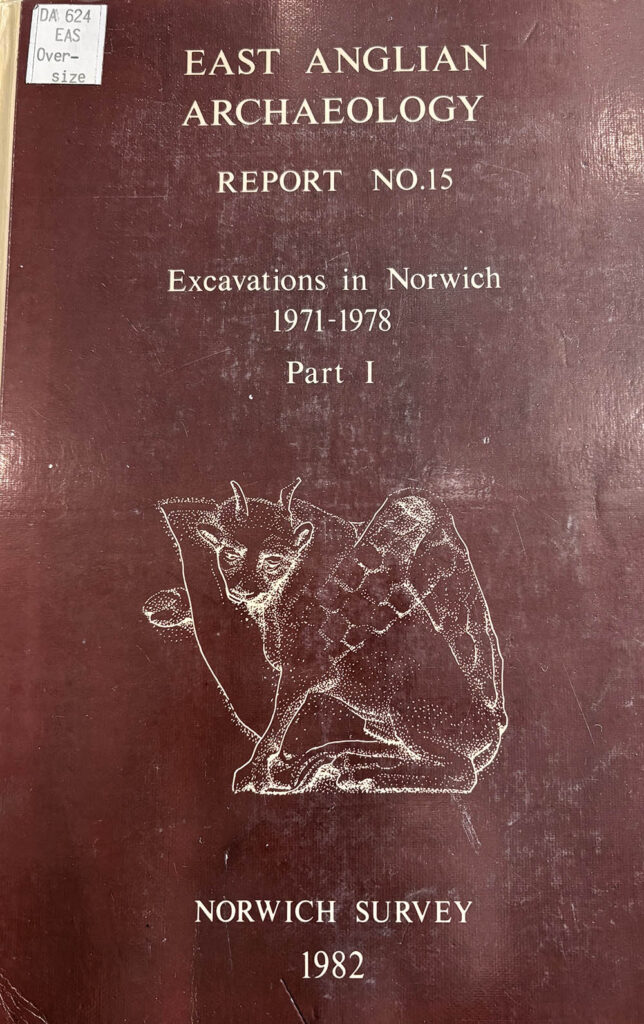
Atkin M., J.P. Roberts, P. Donaldson, H. Sutermeister and A. Carter 1982. Excavations in Norwich 1971-78, Part 1, East Anglian Archaeology 15.
Header and footer photos: Arminghall, 2014, © Nick Stone